
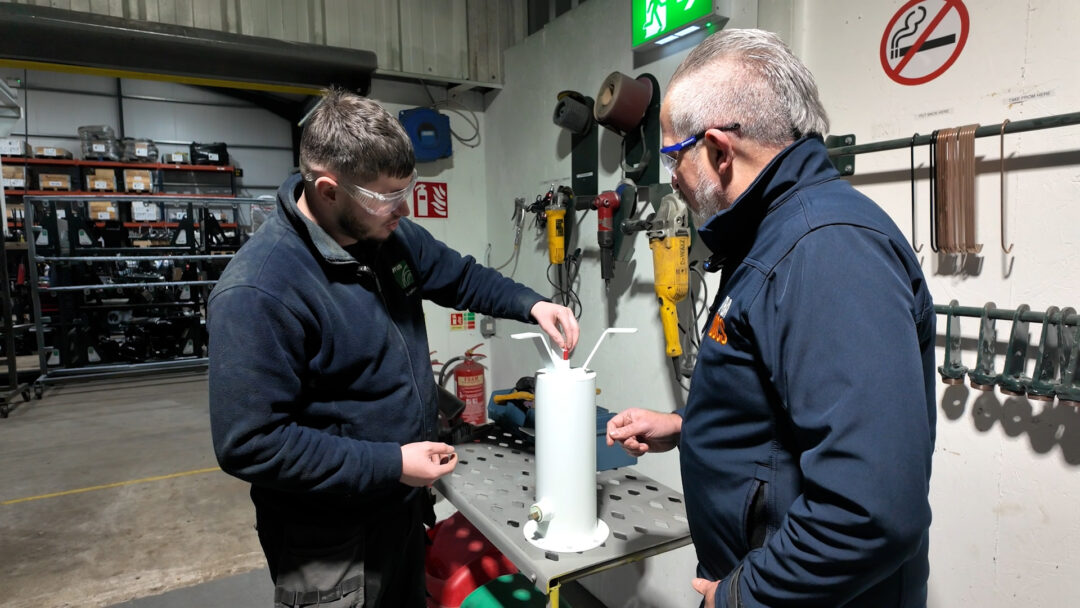

From four weeks to one day. A flagship product, built end to end in-house, by a team with standard work running from the weld bay to the dispatch desk.
Applied Concepts is a 100% Irish-owned manufacturer based in Birr, Co. Offaly, designing and building portable blasting machines and PTO-driven air compressors for agricultural, construction, and industrial customers across 12 export markets.
Founded by managing director Mark Clendennen, the business employs around 25 people and has built a strong reputation for durable, field-tested equipment made entirely in-house.
What sets Applied apart is the level of control they have over every step of the process. Plasma cutting, press braking, rolling, welding, blasting, and powder coating all happen under one roof. That in-house capability is what gives lean real traction here – and why Kevin Brady’s team keeps finding waste to take out of the operation every single week.
Sector: Machinery Manufacturing
HQ: Ireland
Customer since: 2024
SOPS: 250+
Full lean tour
Walk into Applied Concepts and it’s clear that standard work isn’t an aspiration, it’s how the place runs. Every product has its own jig, its own drawing, and its own GembaDocs SOP posted at the point of use, with a QR code on the fixture that pulls up a step-by-step build video on the spot. Variation is designed out before an operator picks up a tool. The flagship Varimount 350, which once took four weeks to build, now gets done in a single day – the result of one-piece flow, tightened standard work, and a team that makes small improvements daily.
Bringing blasting and powder coating in-house, previously split across a second plant ten kilometres away, was one of the biggest turning points. Before the consolidation, trailers were making up to four runs a day between sites. Quality was hard to check. Lead times were unpredictable. Within a few months of pulling everything onto one site, lead times shortened, quality improved, and the team culture visibly shifted. People who had been working in isolation started contributing improvement ideas. Dispatch and the sales office run on the same principle: GembaDocs so thorough that when the dispatch lead was on leave, management stepped in and ran the full process without missing a beat.
It’s worth noting, that before GembaDocs, Kevin’s team was writing SOPs in Word, a process that took around six painful hours per document. Today, the average is ten minutes. As Kevin puts it: the person who needs the SOP is the operator on the floor, not the office staff – and GembaDocs puts that capability where it belongs.
Key Takeaways:
- Flagship product build time cut from four weeks to one day with one-piece flow and standard work
- Welding cycle time reduced from two and a half days to around five hours using standardized jigs – and rework grinding eliminated entirely
- All fabrication, blasting, and powder coating consolidated onto one site – fewer handoffs, better quality, stronger culture
- SOPs at point of use with QR codes on fixtures – the standard is exactly where the work happens
- GembaDocs used across dispatch and the sales office – any team member can cover any process
Improvement
How a Simple Fixing Change That Stopped Paint Damage at the Source
Powder coating quality at Applied Concepts took a hit every time steel fittings cracked the finish during the process. Stephen’s fix was straightforward – swap them out for rubber fittings rated to 200 degrees. No more cracked paint, no more rework, and parts now sit flush in the oven ready for assembly straight off the line.
TAKEAWAYS
- Steel fittings were damaging the powder coat finish – identified as a root cause, not just a quality complaint
- Rubber fittings rated to 200°C replaced them, eliminating the cracking entirely
- Parts can now go straight from the oven into assembly – no rework step in between
A low-cost fix that removed a recurring quality defect and simplified the process
QR + STANDARDS
Scan the Jig, Get the Answer... How QR Codes Make Standards Stick on the Shop Floor
Every hose at Applied Concepts has its own jig, its own drawing, and its own GembaDocs SOP – posted right where the work happens. Kevin took it a step further by adding a QR code directly on each fixture.
Scan it, and the operator gets a step-by-step guide for building that specific unit. No searching, no asking around, no variation. The standard is at the point of use, which is the only place it’s ever going to get followed.
TAKEAWAYS:
- Standards are easiest to follow when they are visible.
- QR codes on fixtures link directly to the GembaDocs SOP for that specific build
- Better access increases adherence to standard work.
Cultural
Moving the Process Was Easy - Shifting the Culture Was the Real Win
When Applied Concepts brought powder coating in-house, the operational gains were obvious – shorter lead times, better quality, fewer handoffs. But Kevin says the biggest change wasn’t on the production board. It was the people.
Staff who had been working in isolation at the off-site plant came into the main facility, saw improvements happening around them, and started making their own. People who previously had no voice in how things were done began putting ideas forward. As Kevin puts it – and you can see it when you walk the floor – it really shows.
TAKEAWAYS
- Layout changes can drive cultural change.
- Better communication improved the work environment.
- Team members became more involved in improvement.
LEAN
Fixing the cut Eliminated Grinding Completely!
A small process improvement made a big difference here. By changing the plasma cut so the folded box sits flush, the team eliminated the need for constant grinding and saved minutes every single day.
TAKEAWAYS
- Chalk and measuring tape meant variation every single time – operator-dependent, impossible to standardise
- Plasma-cut recesses replaced manual marking and eliminated the grinding step entirely
- Parts now fold flush first time, every time – no rework after welding
WASTE REMOVAL
Smaller Blast Area, Bigger Results - Hours of Waste Gone
The old blast area meant sweeping grit the full length of a 40-metre floor, shovelling it into a skip, and repeating it twice a day. It was heavy, slow, and nobody’s idea of value-added work. The new compact area fixed that with a built-in grit recovery system: less space, less sweeping, and no more shovelling steel. Better visibility in the smaller booth also meant quality went up. Parts that used to go back for rework are now coming out right first time.
TAKEAWAYS
- The old layout required sweeping and shovelling grit across a 40-metre floor – hours of non-value-added work every day
- A smaller blast area with a built-in recovery system eliminated the sweeping and shovelling entirely
- Better visibility in the new booth made it easier to see blast coverage – reducing rework at this stage
- Redesigning the space removed waste at the process level, not just around the edges
SOPs & TASKS
How to Do It (SOPs) and When to Do It (Tasks) in Powder Coating Department
GembaDocs does two jobs in the powder coating area. The SOPs make sure anyone can step in and run the process to the same standard – no relying on one person, no knowledge walking out the door. The task board handles the other problem: the daily, weekly, and monthly jobs that are easy to forget when you’re busy. Each card has a QR code that pulls up exactly what needs doing. Scan it, do it, flip it to green.
TAKEAWAYS
- SOPs removed the single-person dependency on the powder coating process – anyone can now do the job to the same standard
- A visual task board tracks daily, weekly, and monthly jobs that would otherwise get missed
- QR codes on each task card link to exactly what needs doing and how
- Between the two, nothing gets forgotten and no step gets done differently by different people
SOPs
The Best Test of a SOP Is When the Expert Isn't There
When Tristan was out, dispatch still ran because every step had already been documented in GembaDocs. From packing to labeling to choosing the right courier, the process was clear enough for anyone to step in and do it correctly.
TAKEAWAYS
- Tristan’s GembaDocs covered every step of dispatch – packing, labeling, addressing, courier selection
- Management stepped in with zero dispatch experience and ran the process without issue
- The documentation was thorough enough that no prior knowledge of the job was needed
- A well-documented process means the work doesn’t stop when the person who owns it isn’t there
SOPs
Lean Doesn't Stop at the Shop Floor - How the Sales Team Runs on Standard Work
Most lean tours don’t make it past the production floor. The sales team at Applied Concepts is documenting key tasks so others can step in when needed, whether that is setting up customers, taking payments, or updating systems. The goal is simple: make critical office work standardized, shared, and easy to cover.
TAKEAWAYS
- Sales tasks are being documented step by step.
- SOPs cover everything from setting up customers on QuickBooks to handling EU tax numbers correctly.
- Lean principles applied in the office deliver the same result as on the floor – consistency and cover when people are away.
LEAN
Tired of Hunting for Tools - Tristan Built the Fix on Wheels
The dispatch trolley at Applied Concepts came out of a simple frustration: too much time walking the floor looking for the drill, the staple gun, the wrap. Tristan’s idea turned that into a single mobile workstation with everything needed to pack a pallet, right where it’s needed. It’s modular too, so the team keeps adding to it as new needs come up. A GembaDocs SOP on the trolley means every machine leaves the building packed the same way, every time.
TAKEAWAYS
- The trolley removes wasted motion.
- Tools and materials are kept at point of use.
- The trolley came directly from an operator identifying a daily frustration – a textbook example of improvement from the floor up
- Modular design means the trolley keeps improving as the team identifies new needs
- A point-of-use SOP ensures every machine is packed and shipped to the same standard every time